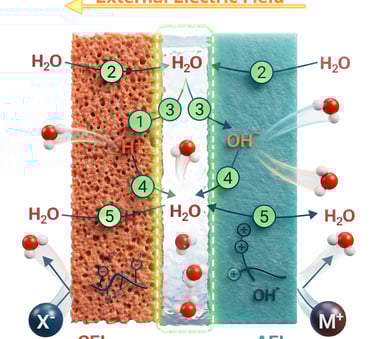
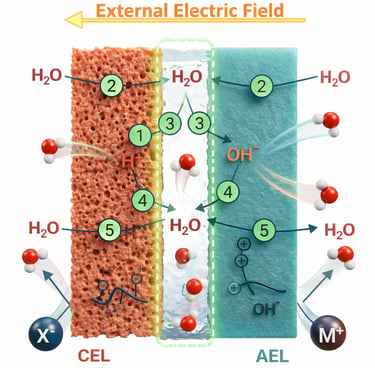
My current research focuses on bipolar membranes (BPMs) with the aim of understanding the fundamental physics of the bipolar junction, where water dissociation and ion generation occur under an applied electric field. Rather than evaluating BPMs only through overall performance metrics, my work seeks to identify the mechanisms that govern water dissociation, ion transport, and energy losses at the junction.
A key aspect of this research is distinguishing whether BPM performance is limited by junction reaction kinetics, local electric field strength, or ion transport through the cation- and anion-exchange layers. I investigate how charge accumulation, hydration, membrane thickness, and fixed-charge density influence junction behavior, particularly under high current densities where efficiency losses become significant.
Using electrochemical diagnostics such as impedance spectroscopy and polarization analysis, I aim to separate bulk membrane resistance from junction-specific contributions. The broader goal is to establish physics-based design principles for BPM junctions that enable efficient, stable operation in applications such as acid–base generation, electrochemical separations, and energy conversion systems.
Supervisor:
Prof Alicia AN (HKUST)
Duration: 2025-Present
Project Details
Bipolar Membranes and Junction Physics
Connect
Explore my academic journey and research publications.
Contact me
hkumar@connect.ust.hk
himanshu19961270@gmail.com
© 2025. All rights reserved.