Biochar-Based Soil and Geoenvironmental Engineering
My research centers on biochar as a multifunctional geomaterial for solving critical challenges in soil cracking, water retention, and geoenvironmental sustainability. Over the past several years, I have systematically investigated how biochar derived from different feedstocks (plant-based, animal-based, and engineered/nano-biochars) interacts with soil under realistic environmental conditions such as drying–wetting cycles, compaction, and extreme moisture gradients.
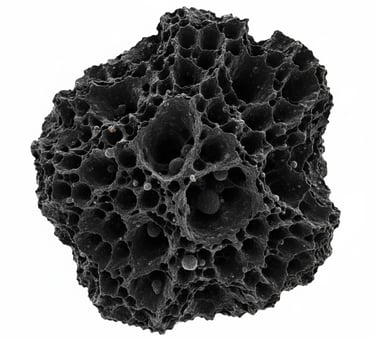
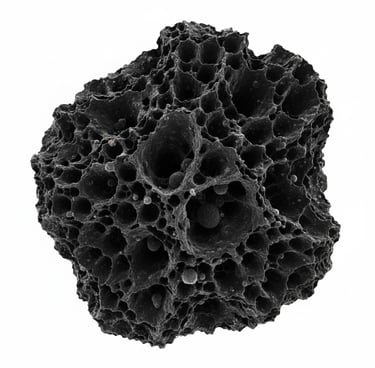
Rather than treating biochar as a black-box additive, my work focuses on mechanism-driven understanding—linking biochar’s microstructure, surface chemistry, and pore architecture to macroscopic soil behavior.
Understanding and Mitigating Soil Cracking Using Biochar
One of the core themes of my work is desiccation crack formation in soils, a critical issue in landfill liners, covers, embankments, and arid-region soils. Through controlled laboratory experiments combined with image-based crack quantification, I demonstrated that biochar can significantly reduce crack intensity by:
Increasing water retention capacity
Redistributing shrinkage-induced stresses
Enhancing soil plasticity and internal bonding
I introduced quantitative crack intensity factor (CIF)–based frameworks and showed that biochar content, compaction state, and plastic limit are the dominant parameters controlling crack evolution. Using multiple regression modeling, I developed predictive relationships that allow crack intensity to be estimated directly from basic soil and biochar properties, offering a practical design tool for geoenvironmental engineers gfh.
Feedstock Matters: Plant vs. Animal Biochars
A major contribution of my research is the comparative evaluation of biochars from different origins, particularly:
Wood biochar (plant-based)
Pig manure biochar (animal-based)
I showed that although both are effective, plant-derived biochars consistently outperform animal-derived biochars in suppressing cracks and retaining moisture. This behavior was linked to:
Higher intra- and inter-pore volume
Greater availability of hydroxyl and oxygen-containing functional groups
More stable pore networks during drying–wetting cycles
These findings provide clear guidance for biochar selection depending on the target application—landfill liners, covers, or agricultural soils.
Biochar vs. Conventional Soil Amendments
To place biochar in a broader engineering context, I conducted systematic comparisons with conventional and emerging soil amendments, including:
Fly ash
Gypsum
Zeolite
Graphene
By simultaneously evaluating cracking behavior, water retention, and shear strength, I demonstrated that biochar uniquely balances hydraulic, mechanical, and durability performance. Unlike many industrial or synthetic additives, biochar improves soil behavior without inducing brittleness or excessive stiffness, making it particularly attractive for long-term environmental applications gfh.
Coupling Experiments with Data-Driven Modeling
Beyond experimentation, my work integrates statistical and data-driven modeling to extract generalizable insights. I employed:
Multiple regression analysis (MRA)
Sensitivity analysis of governing parameters
Image-based quantification techniques
This approach bridges the gap between fundamental soil mechanics and practical prediction, enabling engineers to move from trial-and-error toward performance-based design of biochar-amended soils.
Sustainability and Circular Economy Perspective
A defining motivation behind my research is sustainability. The biochars used in my studies are derived from:
Agricultural residues
Animal waste
Invasive or waste biomass
By converting waste streams into high-value engineering materials, my work contributes to:
Carbon sequestration
Waste valorization
Low-cost, scalable solutions for environmental protection
Supervisor:
Prof Sredeep S. (IIT Guwahati)
Prof. Ankit Garg (XJTL University)
Prof. Sanadam Bordoloi (Aalto University)
Duration: 2017-2019
Project Details
Biochar-Based Soil and Geoenvironmental Engineering
Connect
Explore my academic journey and research publications.
Contact me
hkumar@connect.ust.hk
himanshu19961270@gmail.com
© 2025. All rights reserved.